
Enhancing Mineral Exploration Through Advanced Geophysical Techniques
At Baridi Group Ltd, geophysics plays a critical role in understanding what lies beneath the Earth’s surface. One of the most effective and widely used geophysical exploration methods is Induced Polarization (IP). This technique provides valuable insights into subsurface conditions and is especially useful in the detection of metallic and sulfide bearing mineral deposits.
Induced Polarization is commonly applied in the exploration of economically important minerals such as Copper, Gold, Silver, and various sulfide minerals, including pyrite and chalcopyrite. By using IP surveys, geophysicists are able to identify mineralized zones that may not be visible at the surface, significantly improving exploration accuracy and reducing uncertainty.
How Induced Polarization (IP) Works:
Measuring Electrical Response to Identify Mineralization
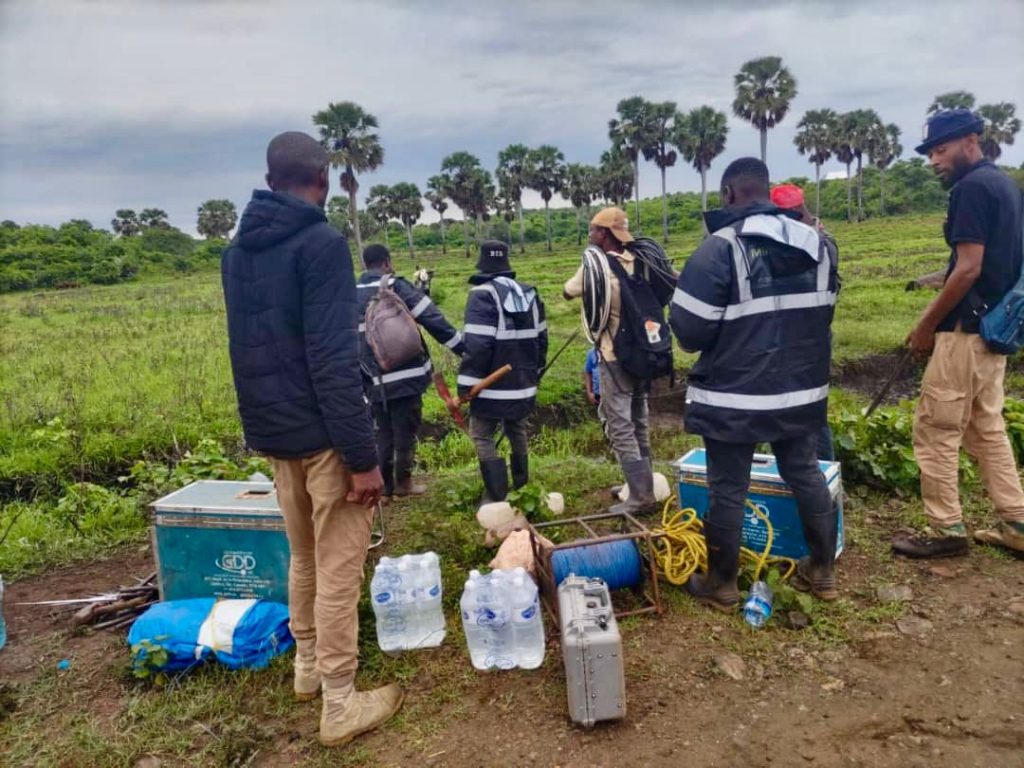
The IP method is based on the way subsurface materials respond to an applied electrical current. During an IP survey, an electric current is injected into the ground through a pair of electrodes placed on the surface. This current travels through the subsurface, interacting with different geological formations and mineral contents.
When the electric current is switched off, certain materials respond differently. Areas that contain metallic minerals, particularly disseminated sulfides, have the ability to temporarily store electrical charge. These areas release the charge slowly, creating a delayed electrical response. This phenomenon is known as chargeability, and it is the key parameter measured in Induced Polarization surveys.
The longer the ground retains the electrical charge, the stronger the indication of potential metallic mineralization.
What Does IP Measure?
Chargeability and Resistivity for Accurate Interpretation
Induced Polarization surveys primarily measure chargeability, which represents the ability of subsurface materials to store electrical charge. High chargeability values often indicate the presence of metallic or sulfide minerals.
However, chargeability alone does not provide a complete picture. For this reason, IP data is commonly interpreted together with resistivity measurements, which indicate how strongly the ground resists the flow of electrical current. The combination of chargeability and resistivity data allows geophysicists to distinguish between different rock types, fluid contents, and mineralization styles.
By integrating these two parameters, Baridi Group Ltd ensures a more accurate and reliable interpretation of subsurface conditions, leading to better exploration decisions.